
Sitemap
A list of all the posts and pages found on the site. For you robots out there, there is an XML version available for digesting as well.
Pages
About me
About Professor Xiaojun Quan
Posts
Future Blog Post
Published:
This post will show up by default. To disable scheduling of future posts, edit config.yml and set future: false.
Blog Post number 4
Published:
This is a sample blog post. Lorem ipsum I can’t remember the rest of lorem ipsum and don’t have an internet connection right now. Testing testing testing this blog post. Blog posts are cool.
Blog Post number 3
Published:
This is a sample blog post. Lorem ipsum I can’t remember the rest of lorem ipsum and don’t have an internet connection right now. Testing testing testing this blog post. Blog posts are cool.
Blog Post number 2
Published:
This is a sample blog post. Lorem ipsum I can’t remember the rest of lorem ipsum and don’t have an internet connection right now. Testing testing testing this blog post. Blog posts are cool.
Blog Post number 1
Published:
This is a sample blog post. Lorem ipsum I can’t remember the rest of lorem ipsum and don’t have an internet connection right now. Testing testing testing this blog post. Blog posts are cool.
portfolio
EMNLP 2025
EMNLP 2025 (Suzhou) 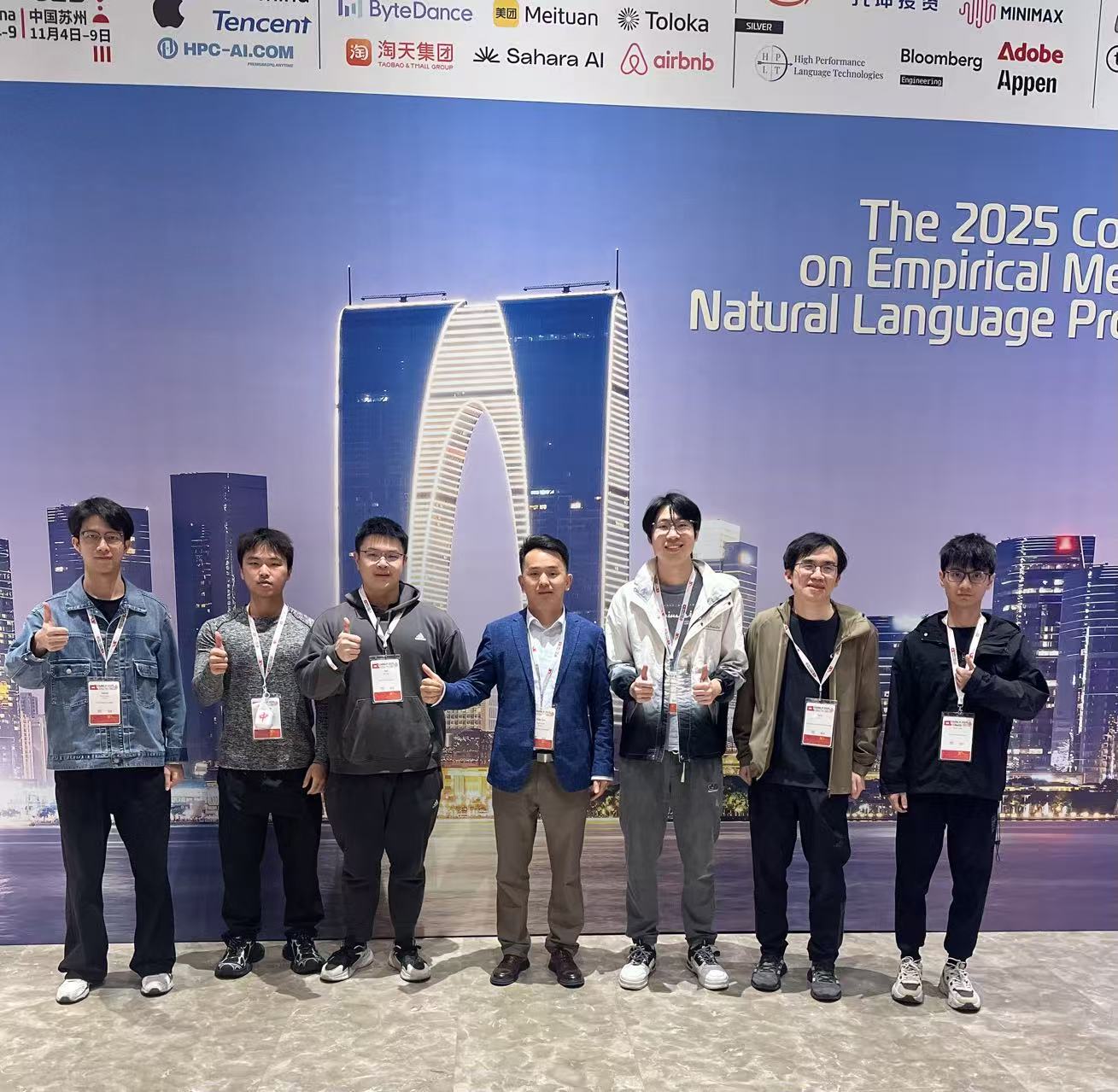
publications
Adaptive Label-Driven Scaling for Latent Semantic Indexing
Published in SIGIR, 2008
Introduces an adaptive label-driven scaling method to enhance Latent Semantic Indexing (LSI).
Recommended citation: Xiaojun Quan, Enhong Chen, Qiming Luo, Hui Xiong. (2008). "Adaptive Label-Driven Scaling for Latent Semantic Indexing." SIGIR 2008.
Download Paper
Short Text Similarity based on Probabilistic Topics
Published in Knowledge and Information Systems, 2010
Calculates similarity between short texts based on their probabilistic topic distributions.
Recommended citation: Xiaojun Quan, Gang Liu, Zhi Lu, Xingliang Ni, Liu Wenyin. (2010). "Short Text Similarity based on Probabilistic Topics." Knowledge and Information Systems 2010.
Download Paper
Discovering Phishing Target Based on Semantic Link Network
Published in Future Generation Computer Systems, 2010
Uses semantic link networks to identify the targets of phishing attacks.
Recommended citation: Liu Wenyin, Ning Fang, Xiaojun Quan, Bite Qiu, Gang Liu. (2010). "Discovering Phishing Target Based on Semantic Link Network." Future Generation Computer Systems 2010.
Download Paper
A Short Text Modeling Method Combining Semantic and Statistic Information
Published in Information Sciences, 2010
Combines semantic knowledge and statistical information to create robust models for short text data.
Recommended citation: Liu Wenyin, Xiaojun Quan, Min Feng. (2010). "A Short Text Modeling Method Combining Semantic and Statistic Information." Information Sciences 2010.
Download Paper
Automatic Categorization of Questions for User-Interactive QA
Published in Information Processing & Management, 2011
Develops automated methods for categorizing questions in interactive QA platforms to improve retrieval.
Recommended citation: Wanpeng Song, Liu Wenyin, Naijie Gu, Xiaojun Quan, Tianyong Hao. (2011). "Automatic Categorization of Questions for User-Interactive QA." Information Processing & Management 2011.
Download Paper
Term Weighting Schemes for Question Categorization
Published in IEEE Transactions on Pattern Analysis and Machine Intelligence, 2011
Evaluates and proposes novel term weighting schemes specifically designed for question categorization tasks.
Recommended citation: Xiaojun Quan, Liu Wenyin, Bite Qiu. (2011). "Term Weighting Schemes for Question Categorization." IEEE Transactions on Pattern Analysis and Machine Intelligence 2011.
Download Paper
Short Text Clustering by Finding Core Terms
Published in Knowledge and Information Systems, 2011
Improves short text clustering by identifying and utilizing core terms to represent text content.
Recommended citation: Xingliang Ni, Xiaojun Quan, Zhi Lu, Liu Wenyin, Bei Hua. (2011). "Short Text Clustering by Finding Core Terms." Knowledge and Information Systems 2011.
Download Paper
User Interest Modeling and Its Application for Question Recommendation
Published in Information Processing & Management, 2012
Models user interests to recommend relevant questions in user-interactive Question Answering systems.
Recommended citation: Xingliang Ni, Yao Lu, Xiaojun Quan, Liu Wenyin, Bei Hua. (2012). "User Interest Modeling and Its Application for Question Recommendation." Information Processing & Management 2012.
Download Paper
Antiphishing through Phishing Target Discovery
Published in IEEE Internet Computing, 2012
Proposes a method to combat phishing by discovering the intended targets of phishing websites.
Recommended citation: Liu Wenyin, Gang Liu, Bite Qiu, Xiaojun Quan. (2012). "Antiphishing through Phishing Target Discovery." IEEE Internet Computing 2012.
Download Paper
Link Graph Analysis for Business Site Selection
Published in IEEE Computer, 2012
Applies link graph analysis techniques to the problem of optimal business site selection.
Recommended citation: Xiaojun Quan, Hui Xiong, Wenyu Dou, Liu Wenyin, Yong Ge. (2012). "Link Graph Analysis for Business Site Selection." IEEE Computer 2012.
Download Paper
Emotion Tagging for Comments of Online News by Meta Classification
Published in SIGIR, 2012
Uses meta-classification with heterogeneous information sources to tag emotions in online news comments.
Recommended citation: Ying Zhang, Luo Si, Xiaojun Quan, Yi Fang, Lin Dai, Xiaojie Yuan. (2012). "Emotion Tagging for Comments of Online News by Meta Classification." SIGIR 2012.
Download Paper
Feature Selection for High-Dimensional Imbalanced Data
Published in Neurocomputing, 2013
Addresses the challenges of feature selection in high-dimensional imbalanced datasets.
Recommended citation: Liuzhi Yin, Yong Ge, Keli Xiao, Xuehua Wang, Xiaojun Quan. (2013). "Feature Selection for High-Dimensional Imbalanced Data." Neurocomputing 2013.
Download Paper
Non-monotonic Sentence Alignment via Semisupervised Learning
Published in ACL, 2013
Proposes a semi-supervised learning approach for non-monotonic sentence alignment in parallel corpora.
Recommended citation: Xiaojun Quan, Chunyu Kit, Yan Song. (2013). "Non-monotonic Sentence Alignment via Semisupervised Learning." ACL 2013.
Download Paper
Towards Building a Social Emotion Detection System for Online News
Published in Future Generation Computer Systems, 2014
Describes the architecture and implementation of a system for detecting social emotions in online news.
Recommended citation: Jingsheng Lei, Yanghui Rao, Xiaojun Quan, Qing Li, Liu Wenyin. (2014). "Towards Building a Social Emotion Detection System for Online News." Future Generation Computer Systems 2014.
Download Paper
Affective topic model for social emotion detection
Published in Neural Networks, 2014
Introduces an affective topic model to capture latent emotional themes in social media text.
Recommended citation: Yanghui Rao, Qing Li, Wenyin Liu, Qingyuan Wu, Xiaojun Quan. (2014). "Affective topic model for social emotion detection." Neural Networks 2014.
Download Paper
Regularizing Flat Latent Variables with Hierarchical Topic Structures
Published in IJCAI, 2015
Regularizes flat latent variables by incorporating hierarchical topic structures to improve model performance.
Recommended citation: Rongcheng Lin, Huayu Li, Xiaojun Quan, Richang Hong, Zhiang Wu, Yong Ge. (2015). "Regularizing Flat Latent Variables with Hierarchical Topic Structures." IJCAI 2015.
Download Paper
Short and Sparse Text Topic Modeling via Self-Aggregation
Published in IJCAI, 2015
Addresses sparsity in short texts by using self-aggregation strategies for more robust topic modeling.
Recommended citation: Xiaojun Quan, Chunyu KIT, Yong Ge, Sinno Jialin Pan. (2015). "Short and Sparse Text Topic Modeling via Self-Aggregation." IJCAI 2015.
Download Paper
Latent Discriminative Models for Social Emotion Detection
Published in ACM Transactions on Information Systems, 2015
Proposes latent discriminative models that incorporate emotional dependency for social emotion detection.
Recommended citation: Xiaojun Quan, Qifan Wang, Ying Zhang, Luo Si, Liu Wenyin. (2015). "Latent Discriminative Models for Social Emotion Detection." ACM Transactions on Information Systems 2015.
Download Paper
Towards Non-Monotonic Sentence Alignment
Published in Information Sciences, 2015
Investigates algorithms for non-monotonic sentence alignment, addressing complex cross-lingual correspondences.
Recommended citation: Xiaojun Quan, Chunyu Kit. (2015). "Towards Non-Monotonic Sentence Alignment." Information Sciences 2015.
Download Paper
BiSET: Bi-directional Selective Encoding with Template for Abstractive Summarization
Published in ACL, 2019
Introduces BiSET, a model using bi-directional selective encoding and templates for high-quality abstractive summarization.
Recommended citation: Kai Wang, Xiaojun Quan, Rui Wang. (2019). "BiSET: Bi-directional Selective Encoding with Template for Abstractive Summarization." ACL 2019.
Download Paper
A Deep Neural Information Fusion Architecture for Textual Network Embeddings
Published in EMNLP-IJCNLP, 2019
A deep neural architecture designed to fuse information for effective textual network embeddings.
Recommended citation: Zenan Xu, Qinliang Su, Xiaojun Quan, Weijia Zhang. (2019). "A Deep Neural Information Fusion Architecture for Textual Network Embeddings." EMNLP-IJCNLP 2019.
Download Paper
Generating Multi-hop Reasoning Questions to Improve MRC
Published in WWW, 2020
Proposes generating multi-hop reasoning questions as a data augmentation strategy to improve Machine Reading Comprehension.
Recommended citation: Jianxing Yu, Xiaojun Quan, Qinliang Su, Jian Yin. (2020). "Generating Multi-hop Reasoning Questions to Improve MRC." WWW 2020.
Download Paper
Conditional Augmentation for Aspect Term Extraction via Masked Seq2Seq
Published in ACL, 2020
Uses a masked sequence-to-sequence generation approach for conditional data augmentation in aspect term extraction.
Recommended citation: Kun Li, Chengbo Chen, Xiaojun Quan, Qing Ling, Yan Song. (2020). "Conditional Augmentation for Aspect Term Extraction via Masked Seq2Seq." ACL 2020.
Download Paper
Joint Chinese Word Segmentation and Part-of-speech Tagging
Published in ACL, 2020
A joint model for Chinese Word Segmentation and POS tagging utilizing two-way attentions of auto-analyzed knowledge.
Recommended citation: Yuanhe Tian, Yan Song, Xiang Ao, Fei Xia, Xiaojun Quan, Tong Zhang, Yonggang Wang. (2020). "Joint Chinese Word Segmentation and Part-of-speech Tagging." ACL 2020.
Download Paper
Low-Resource Generation of Multi-hop Reasoning Questions
Published in ACL, 2020
Addresses the challenge of generating multi-hop reasoning questions in low-resource scenarios.
Recommended citation: Jianxing Yu, Wei Liu, Shuang Qiu, Qinliang Su, Kai Wang, Xiaojun Quan, Jian Yin. (2020). "Low-Resource Generation of Multi-hop Reasoning Questions." ACL 2020.
Download Paper
Multi-Domain Dialogue Acts and Response Co-Generation
Published in ACL, 2020
A co-generation framework that simultaneously generates dialogue acts and responses in multi-domain settings.
Recommended citation: Kai Wang, Junfeng Tian, Rui Wang, Xiaojun Quan, Jianxing Yu. (2020). "Multi-Domain Dialogue Acts and Response Co-Generation." ACL 2020.
Download Paper
Relational Graph Attention Network for Aspect-based Sentiment Analysis
Published in ACL, 2020
Applies Relational Graph Attention Networks (R-GAT) to capture syntactic dependencies for aspect-based sentiment analysis.
Recommended citation: Kai Wang, Weizhou Shen, Yunyi Yang, Xiaojun Quan, Rui Wang. (2020). "Relational Graph Attention Network for Aspect-based Sentiment Analysis." ACL 2020.
Download Paper
Constituency Lattice Encoding for Aspect Term Extraction
Published in COLING, 2020
Incorporates constituency lattice information into encoding for more accurate aspect term extraction.
Recommended citation: Yunyi Yang, Kun Li, Xiaojun Quan, Weizhou Shen, Qinliang Su. (2020). "Constituency Lattice Encoding for Aspect Term Extraction." COLING 2020.
Download Paper
Embedding Dynamic Attributed Networks by Modeling the Evolution Processes
Published in COLING, 2020
Embeds dynamic attributed networks by explicitly modeling their temporal evolution processes.
Recommended citation: Zenan Xu, Zijing Ou, Qinliang Su, Jianxing Yu, Xiaojun Quan, Zhenkun Lin. (2020). "Embedding Dynamic Attributed Networks by Modeling the Evolution Processes." COLING 2020.
Download Paper
Multi-choice Relational Reasoning for Machine Reading Comprehension
Published in COLING, 2020
Proposes a relational reasoning approach for multi-choice machine reading comprehension tasks.
Recommended citation: Wuya Chen, Xiaojun Quan, Chunyu Kit, Zhengcheng Min, Jiahai Wang. (2020). "Multi-choice Relational Reasoning for Machine Reading Comprehension." COLING 2020.
Download Paper
Multi-hop Reasoning Question Generation and Its Application
Published in IEEE Transactions on Knowledge and Data Engineering, 2021
Explores the generation of multi-hop reasoning questions and its applications in QA systems. DOI: 10.1109/TKDE.2021.3073227.
Recommended citation: Jianxing Yu, Qinliang Su, Xiaojun Quan, Jian Yin. (2021). "Multi-hop Reasoning Question Generation and Its Application." IEEE Transactions on Knowledge and Data Engineering 2021.
Download Paper
DialogXL: All-in-One XLNet for Multi-Party Conversation Emotion Recognition
Published in AAAI, 2021
Adapts XLNet for multi-party conversation emotion recognition, capturing long-range context and dependencies.
Recommended citation: Weizhou Shen, Junqing Chen, Xiaojun Quan, Zhixian Xie. (2021). "DialogXL: All-in-One XLNet for Multi-Party Conversation Emotion Recognition." AAAI 2021.
Download Paper
Multi-Document Transformer for Personality Detection
Published in AAAI, 2021
A Multi-Document Transformer architecture designed to aggregate information from multiple user documents for personality detection.
Recommended citation: Feifan Yang, Xiaojun Quan, Yunyi Yang, Jianxing Yu. (2021). "Multi-Document Transformer for Personality Detection." AAAI 2021.
Download Paper
UBAR: Towards Fully End-to-End Task-Oriented Dialog System with GPT-2
Published in AAAI, 2021
UBAR is a fully end-to-end task-oriented dialog system built on GPT-2, treating dialog as a sequence generation task.
Recommended citation: Yunyi Yang, Yunhao Li, Xiaojun Quan. (2021). "UBAR: Towards Fully End-to-End Task-Oriented Dialog System with GPT-2." AAAI 2021.
Download Paper
Progressive Dialogue State Tracking for Multi-Domain Dialogue Systems
Published in ICASSP, 2021
A progressive approach to dialogue state tracking that handles multi-domain transitions effectively.
Recommended citation: Jiahao Wang, Minqian Liu, Xiaojun Quan. (2021). "Progressive Dialogue State Tracking for Multi-Domain Dialogue Systems." ICASSP 2021.
Download Paper
Bi-Granularity Contrastive Learning for Post-Training in Few-Shot Scene
Published in ACL, 2021
Proposes bi-granularity contrastive learning to enhance post-training for few-shot learning scenarios.
Recommended citation: Ruikun Luo, Guanhuan Huang, Xiaojun Quan. (2021). "Bi-Granularity Contrastive Learning for Post-Training in Few-Shot Scene." ACL 2021.
Download Paper
Directed Acyclic Graph Network for Conversational Emotion Recognition
Published in ACL, 2021
Utilizes a Directed Acyclic Graph (DAG) network to model the information flow in conversations for emotion recognition.
Recommended citation: Weizhou Shen, Siyue Wu, Yunyi Yang, Xiaojun Quan. (2021). "Directed Acyclic Graph Network for Conversational Emotion Recognition." ACL 2021.
Download Paper
Psycholinguistic Tripartite Graph Network for Personality Detection
Published in ACL, 2021
Constructs a tripartite graph incorporating psycholinguistic features to enhance personality detection accuracy.
Recommended citation: Tao Yang, Feifan Yang, Haolan Ouyang, Xiaojun Quan. (2021). "Psycholinguistic Tripartite Graph Network for Personality Detection." ACL 2021.
Download Paper
Retrieve & Memorize: Dialog Policy Learning with Multi-Action Memory
Published in ACL, 2021
A ‘Retrieve & Memorize’ framework for dialog policy learning that utilizes multi-action memory.
Recommended citation: Yunhao Li, Yunyi Yang, Xiaojun Quan, Jianxing Yu. (2021). "Retrieve & Memorize: Dialog Policy Learning with Multi-Action Memory." ACL 2021.
Download Paper
Syntax-Enhanced Pre-trained Model
Published in ACL, 2021
Integrates syntactic information into pre-trained models to improve their understanding of sentence structure.
Recommended citation: Zenan Xu, Daya Guo, Duyu Tang, Qinliang Su, Linjun Shou, Ming Gong, Wanjun Zhong, Xiaojun Quan, Daxin Jiang, Nan Duan. (2021). "Syntax-Enhanced Pre-trained Model." ACL 2021.
Download Paper
Learning to Answer Psychological Questionnaire for Personality Detection
Published in EMNLP, 2021
A novel approach that detects personality by learning to answer psychological questionnaires.
Recommended citation: Feifan Yang, Tao Yang, Xiaojun Quan, Qinliang Su. (2021). "Learning to Answer Psychological Questionnaire for Personality Detection." EMNLP 2021.
Download Paper
Compound Aspect Extraction by Augmentation and Constituency Lattice
Published in IEEE Transactions on Affective Computing, 2022
Focuses on compound aspect extraction using data augmentation and constituency lattices. DOI: 10.1109/TAFFC.2022.3161683.
Recommended citation: Xiaojun Quan, Zhengcheng Min, Kun Li, Yunyi Yang. (2022). "Compound Aspect Extraction by Augmentation and Constituency Lattice." IEEE Transactions on Affective Computing 2022.
Download Paper
WebFormer: The Web-page Transformer for Structure Information Extraction
Published in WWW, 2022
Introduces WebFormer, a Transformer architecture tailored for extracting structured information from web pages.
Recommended citation: Qifan Wang, Yi Fang, Anirudh Ravula, Fuli Feng, Xiaojun Quan, Dongfang Liu. (2022). "WebFormer: The Web-page Transformer for Structure Information Extraction." WWW 2022.
Download Paper
GL-RG: Global-Local Representation Granularity for Video Captioning
Published in IJCAI, 2022
Combines global and local representation granularities to generate more precise and descriptive video captions.
Recommended citation: Liqi Yan, Yiming Cui, Qifan Wang, Xiangyu Zhang, Fuli Feng, Dongfang Liu, Xiaojun Quan. (2022). "GL-RG: Global-Local Representation Granularity for Video Captioning." IJCAI 2022.
Download Paper
Autoregressive Entity Generation for End-to-End Task-Oriented Dialog
Published in COLING, 2022
Proposes an autoregressive entity generation approach for more accurate slot filling in end-to-end task-oriented dialogs.
Recommended citation: Guanhuang Huang, Xiaojun Quan, Qifan Wang. (2022). "Autoregressive Entity Generation for End-to-End Task-Oriented Dialog." COLING 2022.
Download Paper
AD-DROP: Attribution Driven Dropout for Robust Language Model Finetuning
Published in NeurIPS, 2022
Introduces an attribution-driven dropout mechanism to improve the robustness and generalization of fine-tuned language models.
Recommended citation: Tao Yang, Jinghao Deng, Xiaojun Quan, Qifan Wang, Shaoliang Nie. (2022). "AD-DROP: Attribution Driven Dropout for Robust Language Model Finetuning." NeurIPS 2022.
Download Paper
Learning to Generate Question by Asking Question: A Primal-Dual Approach
Published in EMNLP, 2022
A Primal-Dual approach with uncommon word generation to improve question generation quality.
Recommended citation: Qifan Wang, Li Yang, Xiaojun Quan, Fuli Feng, Dongfang Liu, Zenglin Xu, Sinong Wang, Hao Ma. (2022). "Learning to Generate Question by Asking Question: A Primal-Dual Approach." EMNLP 2022.
Download Paper
XPrompt: Exploring the Extreme of Prompt Tuning
Published in EMNLP, 2022
Explores the boundaries of prompt tuning to achieve parameter efficiency without sacrificing performance.
Recommended citation: Fang Ma, Chen Zhang, Lei Ren, Jingang Wang, Qifan Wang, Wei Wu, Xiaojun Quan, Dawei Song. (2022). "XPrompt: Exploring the Extreme of Prompt Tuning." EMNLP 2022.
Download Paper
Multi-Party Conversation Modeling for Emotion Recognition
Published in IEEE Transactions on Affective Computing, 2023
A comprehensive study on modeling multi-party conversations for emotion recognition. DOI: 10.1109/TAFFC.2023.3273589.
Recommended citation: Xiaojun Quan, Siyue Wu, Junqing Chen, Weizhou Shen, Jianxing Yu. (2023). "Multi-Party Conversation Modeling for Emotion Recognition." IEEE Transactions on Affective Computing 2023.
Download Paper
A Graph Fusion Approach for Cross-Lingual Machine Reading Comprehension
Published in AAAI, 2023
A graph fusion method designed to transfer reading comprehension capabilities across languages effectively.
Recommended citation: Zenan Xu, Linjun Shou, Jian Pei, Ming Gong, Qinliang Su, Xiaojun Quan, Daxin Jiang. (2023). "A Graph Fusion Approach for Cross-Lingual Machine Reading Comprehension." AAAI 2023.
Download Paper
Orders Are Unwanted: Dynamic Deep Graph Convolutional Network for Personality Detection
Published in AAAI, 2023
Proposes a dynamic deep graph convolutional network to address the issue of unwanted order effects in personality detection datasets.
Recommended citation: Tao Yang, Jinghao Deng, Xiaojun Quan, Qifan Wang. (2023). "Orders Are Unwanted: Dynamic Deep Graph Convolutional Network for Personality Detection." AAAI 2023.
Download Paper
Generic Dependency Modeling for Multi-Party Conversation
Published in ICASSP, 2023
Models generic dependencies in multi-party conversations to improve context understanding and response generation.
Recommended citation: Weizhou Shen, Xiaojun Quan, Ke Yang. (2023). "Generic Dependency Modeling for Multi-Party Conversation." ICASSP 2023.
Download Paper
AD-KD: Attribution-Driven Knowledge Distillation for Language Model Compression
Published in ACL, 2023
Explores token-level rationale from teacher models based on Integrated Gradients to transfer attribution knowledge to student models.
Recommended citation: Siyue Wu, Hongzhan Chen, Xiaojun Quan, Qifan Wang, Rui Wang. (2023). "AD-KD: Attribution-Driven Knowledge Distillation for Language Model Compression." ACL 2023.
Download Paper
Clustering-Aware Negative Sampling for Unsupervised Sentence Representation
Published in ACL, 2023
Proposes a clustering-aware negative sampling strategy to improve unsupervised sentence representation learning.
Recommended citation: Jinghao Deng, Fanqi Wan, Tao Yang, Xiaojun Quan, Rui Wang. (2023). "Clustering-Aware Negative Sampling for Unsupervised Sentence Representation." ACL 2023.
Download Paper
Disentangled Phonetic Representation for Chinese Spelling Correction
Published in ACL, 2023
Investigates disentangled phonetic representations to accurately capture pronunciation features for Chinese Spelling Correction.
Recommended citation: Zihong Liang, Xiaojun Quan, Qifan Wang. (2023). "Disentangled Phonetic Representation for Chinese Spelling Correction." ACL 2023.
Download Paper
Joint Generator-Ranker Learning for Natural Language Generation
Published in ACL, 2023
A joint learning framework that iteratively optimizes a generator and a ranker for high-quality natural language generation.
Recommended citation: Weizhou Shen, Yeyun Gong, Yelong Shen, Song Wang, Xiaojun Quan, Nan Duan, Weizhu Chen. (2023). "Joint Generator-Ranker Learning for Natural Language Generation." ACL 2023.
Download Paper
MixPAVE: Mix-Prompt Tuning for Few-shot Product Attribute Value Extraction
Published in ACL, 2023
A Mix-Prompt Tuning approach for few-shot product attribute extraction in e-commerce scenarios.
Recommended citation: Li Yang, Qifan Wang, Jingang Wang, Xiaojun Quan, Fuli Feng, Yu Chen, Madian Khabsa, Sinong Wang, Zenglin Xu, Dongfang Liu. (2023). "MixPAVE: Mix-Prompt Tuning for Few-shot Product Attribute Value Extraction." ACL 2023.
Download Paper
Multi-Grained Knowledge Retrieval for End-to-End Task-Oriented Dialog
Published in ACL, 2023
Proposes a multi-grained knowledge retrieval approach to enhance the performance of end-to-end task-oriented dialogue systems.
Recommended citation: Fanqi Wan, Weizhou Shen, Ke Yang, Xiaojun Quan, Wei Bi. (2023). "Multi-Grained Knowledge Retrieval for End-to-End Task-Oriented Dialog." ACL 2023.
Download Paper
MUSTIE: Multimodal Structural Transformer for Web Information Extraction
Published in ACL, 2023
Introduces a multimodal structural transformer designed for efficient and robust web information extraction.
Recommended citation: Qifan Wang, Jingang Wang, Xiaojun Quan, Fuli Feng, Zenglin Xu, Shaoliang Nie, Sinong Wang, Madian Khabsa, Hamed Firooz, Dongfang Liu. (2023). "MUSTIE: Multimodal Structural Transformer for Web Information Extraction." ACL 2023.
Download Paper
APrompt: Attention Prompt Tuning for Efficient Adaptation of Pre-trained Language Models
Published in EMNLP, 2023
Proposes Attention Prompt Tuning (APrompt) for efficient and parameter-efficient adaptation of pre-trained language models.
Recommended citation: Qifan Wang, Yuning Mao, Jingang Wang, Hanchao Yu, Shaoliang Nie, Sinong Wang, Fuli Feng, Lifu Huang, Xiaojun Quan, Zenglin Xu, Dongfang Liu. (2023). "APrompt: Attention Prompt Tuning for Efficient Adaptation of Pre-trained Language Models." EMNLP 2023.
Download Paper
Dual-Feedback Knowledge Retrieval for Task-Oriented Dialogue Systems
Published in EMNLP, 2023
Proposes a dual-feedback mechanism generating positive and negative feedback from the generator to train the retriever in TOD systems.
Recommended citation: Tianyuan Shi, Liangzhi Li, Zijian Lin, Tao Yang, Xiaojun Quan, Qifan Wang. (2023). "Dual-Feedback Knowledge Retrieval for Task-Oriented Dialogue Systems." EMNLP 2023.
Download Paper
Explore-Instruct: Enhancing Domain-Specific Instruction Coverage through Active Exploration
Published in EMNLP, 2023
Enhances domain-specific instruction coverage through active exploration via LLMs using a search algorithm to obtain diversified data.
Recommended citation: Fanqi Wan, Xinting Huang, Tao Yang, Xiaojun Quan, Wei Bi, Shuming Shi. (2023). "Explore-Instruct: Enhancing Domain-Specific Instruction Coverage through Active Exploration." EMNLP 2023.
Download Paper
MCC-KD: Multi-CoT Consistent Knowledge Distillation
Published in EMNLP, 2023
Generates multiple rationales for each question and enforces consistency among predictions by minimizing bidirectional KL-divergence.
Recommended citation: Hongzhan Chen, Siyue Wu, Xiaojun Quan, Rui Wang, Ming Yan, Ji Zhang. (2023). "MCC-KD: Multi-CoT Consistent Knowledge Distillation." EMNLP 2023.
Download Paper
PsyCoT: Psychological Questionnaire as Powerful Chain-of-Thought for Personality Detection
Published in EMNLP, 2023
Mimics human questionnaire completion in a multi-turn dialogue manner to detect personality traits using LLMs.
Recommended citation: Tao Yang, Tianyuan Shi, Fanqi Wan, Xiaojun Quan, Qifan Wang, Bingzhe Wu, Jiaxiang Wu. (2023). "PsyCoT: Psychological Questionnaire as Powerful Chain-of-Thought for Personality Detection." EMNLP 2023.
Download Paper
Retrieval-Generation Alignment for End-to-End Task-Oriented Dialogue System
Published in EMNLP, 2023
Uses maximal marginal likelihood to train a perceptive retriever by utilizing signals from response generation for supervision.
Recommended citation: Weizhou Shen, Yingqi Gao, Canbin Huang, Fanqi Wan, Xiaojun Quan, Wei Bi. (2023). "Retrieval-Generation Alignment for End-to-End Task-Oriented Dialogue System." EMNLP 2023.
Download Paper
Knowledge Fusion of Large Language Models
Published in ICLR, 2024
The pioneering FuseLLM paper. It leverages generative distributions of source LLMs to externalize collective knowledge and transfer it to a target LLM.
Recommended citation: Fanqi Wan, Xinting Huang, Deng Cai, Xiaojun Quan, Wei Bi, Shuming Shi. (2024). "Knowledge Fusion of Large Language Models." ICLR 2024.
Download Paper
Alignment-Enhanced Chinese Grammatical Error Corrector
Published in ACL, 2024
Proposes an alignment-enhanced corrector training both a correction model and an alignment model to address overcorrection in Chinese GEC.
Recommended citation: Haihui Yang, Xiaojun Quan. (2024). "Alignment-Enhanced Chinese Grammatical Error Corrector." ACL 2024.
Download Paper
SocialBench: Sociality Evaluation of Role-Playing Conversational Agents
Published in ACL, 2024
Introduces SocialBench, the first benchmark designed to systematically evaluate the sociality of role-playing agents at individual and group levels.
Recommended citation: Hongzhan Chen, Hehong Chen, Ming Yan, Wenshen Xu, Gao Xing, Weizhou Shen, Xiaojun Quan, Chenliang Li, Ji Zhang, Fei Huang. (2024). "SocialBench: Sociality Evaluation of Role-Playing Conversational Agents." ACL 2024.
Download Paper
Knowledge Verification to Nip Hallucination in the Bud
Published in EMNLP, 2024
Mitigates hallucinations by verifying and minimizing inconsistency between external knowledge in alignment data and the intrinsic knowledge of LLMs.
Recommended citation: Fanqi Wan, Xinting Huang, Leyang Cui, Xiaojun Quan, Wei Bi, Shuming Shi. (2024). "Knowledge Verification to Nip Hallucination in the Bud." EMNLP 2024.
Download Paper
Self-Evolution Fine-Tuning for Policy Optimization
Published in EMNLP, 2024
Introduces SEFT, training an adaptive reviser to elevate low-quality responses and guide policy optimization using unannotated data.
Recommended citation: Ruijun Chen, Jiehao Liang, Shiping Gao, Fanqi Wan, Xiaojun Quan. (2024). "Self-Evolution Fine-Tuning for Policy Optimization." EMNLP 2024.
Download Paper
Small LLMs Are Weak Tool Learners: A Multi-LLM Agent
Published in EMNLP, 2024
Proposes a multi-LLM agent framework decomposing tool learning into planner, caller, and summarizer roles to overcome small model limitations.
Recommended citation: Weizhou Shen, Chenliang Li, Hongzhan Chen, Ming Yan, Xiaojun Quan, Hehong Chen, Ji Zhang, Fei Huang. (2024). "Small LLMs Are Weak Tool Learners: A Multi-LLM Agent." EMNLP 2024.
Download Paper
Lookahead Routing for Large Language Models
Published in NeurIPS, 2025
Presents Lookahead Routing, a method for improving efficiency and performance in large language model inference.
Recommended citation: Canbin Huang, Tianyuan Shi, Yuhua Zhu, Ruijun Chen, Xiaojun Quan. (2025). "Lookahead Routing for Large Language Models." NeurIPS 2025.
Download Paper
Probabilistic Token Alignment for Large Language Model Fusion
Published in NeurIPS, 2025
Proposes probabilistic token alignment to improve the effectiveness of large language model fusion.
Recommended citation: Runjia Zeng, James Chenhao Liang, Cheng Han, Zhiwen Cao, Jiahao Liu, Xiaojun Quan, Yingjie Victor Chen, Lifu Huang, Tong Geng, Qifan Wang, Dongfang Liu. (2025). "Probabilistic Token Alignment for Large Language Model Fusion." NeurIPS 2025.
Download Paper
FuseRL: Dense Preference Optimization for Heterogeneous Model Fusion
Published in arXiv Preprint, 2025
Introduces a reinforcement learning framework for model fusion, combining weighted supervised fine-tuning and weighted preference optimization.
Recommended citation: Longguang Zhong, Fanqi Wan, Ziyi Yang, Guosheng Liang, Tianyuan Shi, Xiaojun Quan. (2025). "FuseRL: Dense Preference Optimization for Heterogeneous Model Fusion." arXiv Preprint 2025.
Download Paper
Advantage-Guided Distillation for Preference Alignment in Small Language Models
Published in ICLR, 2025
Proposes Advantage-Guided Distillation for Preference Alignment (ADPA) to guide the alignment of small language models using nuanced distribution-level signals from teacher models.
Recommended citation: Shiping Gao, Fanqi Wan, Jiajian Guo, Xiaojun Quan, Qifan Wang. (2025). "Advantage-Guided Distillation for Preference Alignment in Small Language Models." ICLR 2025.
Download Paper
FuseChat-3.0: Preference Optimization Meets Heterogeneous Model Fusion
Published in ICLR SCI-FM Workshop, 2025
A study at the intersection of preference optimization and heterogeneous model fusion, enhancing chat capabilities through multi-model integration.
Recommended citation: Ziyi Yang, Fanqi Wan, Longguang Zhong, Canbin Huang, Guosheng Liang, Xiaojun Quan. (2025). "FuseChat-3.0: Preference Optimization Meets Heterogeneous Model Fusion." ICLR SCI-FM Workshop 2025.
Download Paper
Weighted-Reward Preference Optimization for Implicit Model Fusion
Published in ICLR, 2025
Introduces Weighted-Reward Preference Optimization (WRPO), an implicit fusion method enabling capability transfer between LLMs without requiring vocabulary alignment.
Recommended citation: Ziyi Yang, Fanqi Wan, Longguang Zhong, Tianyuan Shi, Xiaojun Quan. (2025). "Weighted-Reward Preference Optimization for Implicit Model Fusion." ICLR 2025.
Download Paper
Discriminative Policy Optimization for Token-Level Reward Models
Published in ICML, 2025
Revisits token-level reward assignment by decoupling reward modeling from language generation and deriving a token-level reward model (Q-RM) through discriminative policy optimization.
Recommended citation: Hongzhan Chen, Tao Yang, Shiping Gao, Ruijun Chen, Xiaojun Quan, Hongtao Tian, Ting Yao. (2025). "Discriminative Policy Optimization for Token-Level Reward Models." ICML 2025.
Download Paper
BlockPruner: Fine-grained Pruning for Large Language Models
Published in ACL, 2025
Targeting redundancies in multi-head attention and MLP blocks, this work proposes a fine-grained, training-free structured pruning approach for LLMs.
Recommended citation: Longguang Zhong, Fanqi Wan, Ruijun Chen, Xiaojun Quan, Liangzhi Li. (2025). "BlockPruner: Fine-grained Pruning for Large Language Models." ACL 2025.
Download Paper
Cool-Fusion: Fuse Large Language Models without Training
Published in ACL, 2025
A training-free fusion approach that ensembles heterogeneous LLMs at the text level and uses reranking to select the best generated segments.
Recommended citation: Cong Liu, Xiaojun Quan, Yan Pan, Weigang Wu, Xu Chen, Liang Lin. (2025). "Cool-Fusion: Fuse Large Language Models without Training." ACL 2025.
Download Paper
Mutual-Taught for Co-adapting Policy and Reward Models
Published in ACL, 2025
Presents Mutual-Taught, a self-training method that iteratively co-adapts policy and reward models during alignment without extra human annotation.
Recommended citation: Tianyuan Shi, Canbin Huang, Fanqi Wan, Longguang Zhong, Ziyi Yang, Weizhou Shen, Xiaojun Quan, Ming Yan. (2025). "Mutual-Taught for Co-adapting Policy and Reward Models." ACL 2025.
Download Paper
FuseChat: Knowledge Fusion of Chat Models
Published in EMNLP, 2025
Part of the FuseLLM series, this work proposes a framework to fuse knowledge from multiple chat models into a unified, more robust chat model.
Recommended citation: Fanqi Wan, Longguang Zhong, Ziyi Yang, Ruijun Chen, Xiaojun Quan. (2025). "FuseChat: Knowledge Fusion of Chat Models." EMNLP 2025.
Download Paper
ReAlign: Structured Revision for Small Language Model Alignment
Published in EMNLP, 2025
Introduces ReAlign, combining on-policy learning stability with reviser-assisted supervision to improve alignment in small language models.
Recommended citation: Ruijun Chen, Jiajian Guo, Hongzhan Chen, Fanqi Wan, Qifan Wang, Xiaojun Quan. (2025). "ReAlign: Structured Revision for Small Language Model Alignment." EMNLP 2025.
Download Paper
ThinkSwitcher: When to Think Hard, When to Think Fast
Published in EMNLP, 2025
Proposes a dynamic framework enabling Large Reasoning Models to switch between short and long Chain-of-Thought modes based on query complexity.
Recommended citation: Guosheng Liang, Longguang Zhong, Ziyi Yang, Xiaojun Quan. (2025). "ThinkSwitcher: When to Think Hard, When to Think Fast." EMNLP 2025.
Download Paper
ProFuser: Progressive Fusion of Large Language Models
Published in AAAI, 2026
Introduces ProFuser, a progressive fusion approach for combining multiple large language models effectively.
Recommended citation: Tianyuan Shi, Fanqi Wan, Canbin Huang, Xiaojun Quan, Chenliang Li, Ming Yan, Ji Zhang, Minhua Huang, Wu Kai. (2026). "ProFuser: Progressive Fusion of Large Language Models." AAAI 2026.
Download Paper
SPELL: Self-Play Reinforcement Learning for Evolving Long-Context Language Models
Published in ICLR, 2026
Proposes SPELL, a self-play reinforcement learning framework for improving long-context capabilities of language models.
Recommended citation: Ziyi Yang, Weizhou Shen, Chenliang Li, Ruijun Chen, Fanqi Wan, Ming Yan, Xiaojun Quan, Fei Huang. (2026). "SPELL: Self-Play Reinforcement Learning for Evolving Long-Context Language Models." ICLR 2026.
Download Paper
ProactiveEval: A Unified Evaluation Framework for Proactive Dialogue Agents
Published in ACL, 2026
Introduces ProactiveEval, a unified framework for evaluating proactive dialogue agents across diverse interaction scenarios.
Recommended citation: Tianjian Liu, Fanqi Wan, Jiajian Guo, Xiaojun Quan. (2026). "ProactiveEval: A Unified Evaluation Framework for Proactive Dialogue Agents." ACL 2026.
Download Paper
talks
Syntax Network for Aspect-Based Sentiment Analysis
Published:
Venue: SMP 2019
Bi-directional Selective Encoding with Template for Abstractive Summarization
Published:
Venue: Alibaba
All-in-One XLNet for Multi-Party Conversation Emotion Recognition
Published:
Venue: 2020 Greater Bay Area Youth AI Academic Conference
Task-Oriented Dialogue Systems and Generation
Published:
Venue: Guangdong University of Technology
Text Generation Methods in Task-Oriented Dialogue Systems
Published:
Venue: 2021 Natural Language Generation and Intelligent Writing Conference
Current Status and Outlook of Natural Language Processing
Published:
Venue: Jinan University
Key Technologies in Large Model Knowledge Distillation
Published:
Venue: Guangzhou YOCSEF
Knowledge Distillation Techniques for Pre-trained Language Models
Published:
Venue: Guangdong University of Foreign Studies
Multi-Source Heterogeneous Large Model Fusion
Published:
Venue: 1st Cognitive Intelligence and Big Data Workshop 2024
Preference Alignment for Weak Language Models
Published:
Venue: ICNLP 2025
AI Technology Supporting High-Quality Development in Guangdong
Published:
Venue: Guangdong Communist Youth League Committee
AI Promotes High-Quality Development in Guangdong
Published:
Venue: Huizhou State-owned Assets Supervision and Administration Commission
Small LLMs Are Weak Tool Learners: A Multi-LLM Agent
Published:
Venue: Pazhou Laboratory
Preference Alignment for Weak Language Models
Published:
Venue: ByteDance
teaching
Scientific Writing
Postgraduate Course, Sun Yat-sen University, 2019
Postgraduate: 2019
Machine Learning and Data Mining
Undergraduate Course, Sun Yat-sen University, 2022
Undergraduate: 2017–2022 (Annually)
Frontiers in Scientific Computing with HPC and AI
Postgraduate Course, Sun Yat-sen University, 2024
Postgraduate: 2023, 2024
Artificial Intelligence
Postgraduate Course, Sun Yat-sen University, 2025
Postgraduate: 2025
Artificial Neural Networks (Deep Learning)
Undergraduate Course, Sun Yat-sen University, 2025
Undergraduate: 2022–2025 (Annually)
Natural Language Processing
Undergraduate & Postgraduate Course, Sun Yat-sen University, 2025
Undergraduate: 2019–2025 (Annually)
Postgraduate: 2021, 2024, 2025